

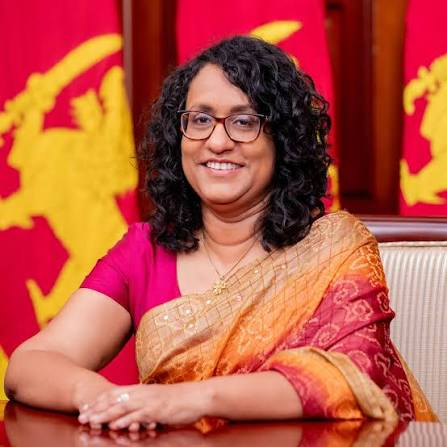
Prime Minister Dr. Harini Amarasuriya yesterday said that Cabinet has approved the report on the establishment of an Education Council and the Education Ministry will take steps to appoint a committee in the near future to prepare the relevant draft legislation.
She also said that Cabinet has also approved the Concept Paper on Education Reforms prepared by the National Education Commission, the revised National Curriculum Framework submitted by the National Institute of Education (NIE) and the Student Assessment Framework for Grades 1 to 11.
“The assessment framework for the G.C.E. Advanced Level is currently being developed”.
The Prime Minister made these remarks at a special discussion held with the Voluntary Advisory Council of the Ministry of Education at the Parliament yesterday (9).
Addressing the meeting, Prime Minister Dr.Harini Amarasuriya further stated: Cabinet approval has been granted for several crucial policies and proposals aimed at bringing about significant qualitative and structural changes to the education system. In particular, Cabinet approval has been granted for the Concept Paper on Education Reforms prepared by the National Education Commission, the revised National Curriculum Framework submitted by the National Institute of Education (NIE), and the Student Assessment Framework for Grades 1 to 11.
The assessment framework for the G.C.E. Advanced Level is currently being developed.
Cabinet has also approved the report on the establishment of an Education Council. The Ministry of Education will take steps to appoint a committee in the near future to prepare the relevant draft legislation.
Further,the policy on the digitalisation of the education sector has been submitted to the President following approval by the National Education Commission. It is scheduled to be presented to the Cabinet of Ministers in due course. A project proposal amounting to Rs. 96 billion, to be implemented over five years to advance digital development in school education, has also received policy-level approval.
A subcommittee has been established to strengthen the quality assurance process in both the state and non-state education sectors.
In addition, the University Grants Commission and other relevant institutions have been instructed to develop a Unified Admissions Policy that would enable students completing their G.C.E. Advanced Level examinations to apply for all higher education options through a single system.
This initiative aims to resolve administrative difficulties arising from the requirement to submit separate applications to universities, National Colleges of Education (NCOEs) and vocational education institutions. The system is expected to be introduced as a pilot project from 2028,” the Prime Minister stated.
Education Deputy Minister Dr.Madhura Seneviratne stated that special committees had been appointed to formulate policies for engineering, medical education including undergraduate courses and postgraduate studies and the agricultural sector within higher education. He further noted that Cabinet approval had been granted for a new policy outlining guidelines for regulating non-state degree-awarding institutions and establishing the criteria for granting degree-awarding status. Officials attending the meeting revealed that a set of guidelines had been developed to ensure students’ online safety and digital well-being, covering five grade groups: Grades 1-2, 3-5, 6-7, 8-10 and 11-13. A pilot project is scheduled to commence in November, with full implementation planned for early next year.
About the Author